
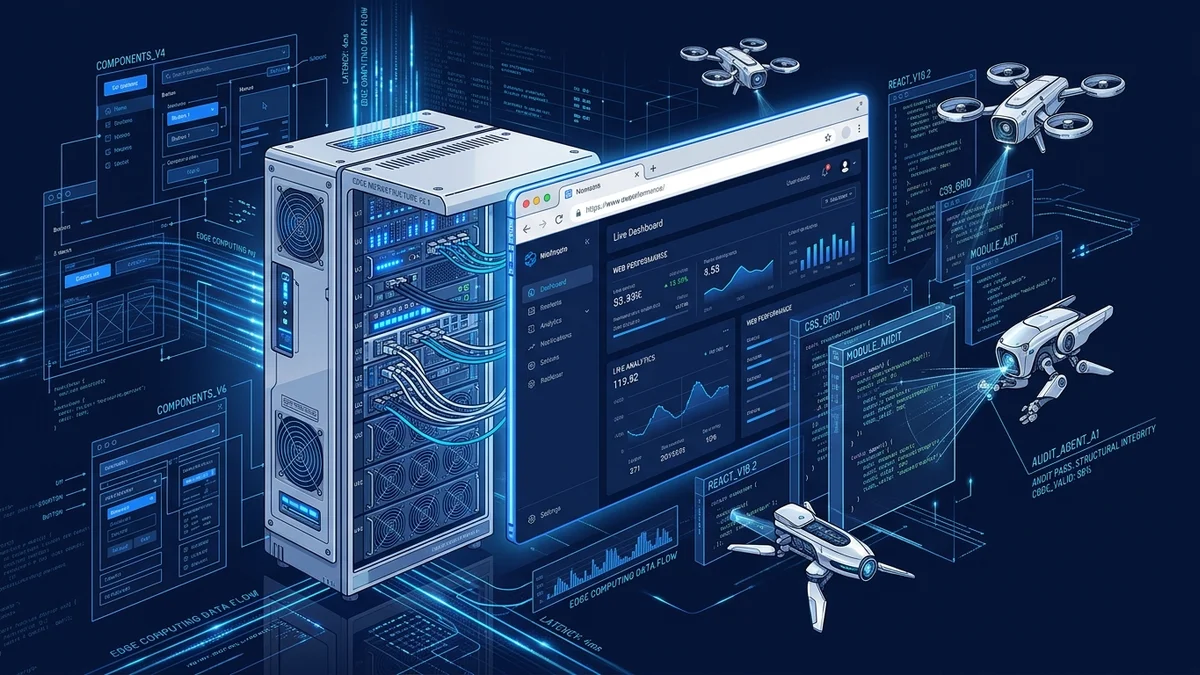
Key Takeaways
- Frontend development in 2025 will shift from client-side heavy lifting to server-side orchestration.
- AI-assisted coding agents will move from productivity tools to standard architectural reviewers.
- Edge computing will become the default deployment tier for high-availability applications.
- Developers will prioritize 'Resilient UI' patterns to mitigate dependency vulnerabilities.
- Platform engineering will bridge the gap between complex infrastructure and frontend velocity.
The speed of innovation in the browser ecosystem remains relentless. As we look toward the 2025 horizon, our predictions suggest a fundamental transformation in how teams build and ship user-facing applications. The era of 'throw everything at the client' is ending, replaced by a sophisticated, infrastructure-aware approach to frontend architecture.
How Will AI Agents Redefine the Developer Workflow?
AI is no longer just a autocomplete feature in your IDE. By 2025, agentic workflows will handle complex refactoring tasks and regression testing automatically.
- Automated Code Audits: AI agents will perform static analysis on every pull request, flagging patterns that violate technical debt thresholds.
- Synthesized Maintenance: Routine dependency updates and security patching will be offloaded to autonomous bots.
- Context-Aware Debugging: AI will correlate logs from distributed systems to pinpoint frontend bottlenecks in milliseconds.
According to recent industry research, teams integrating AI-driven linting report a 40% reduction in production hotfixes. You must focus on building modular architectures that these agents can easily navigate and refactor without manual oversight.
Will Edge-Native Architectures Become the Default?
As user expectations for instant load times intensify, the traditional origin server approach is failing. Moving compute closer to the user is the only way to satisfy global high-availability requirements.
The shift to edge-native frameworks reduces Time to First Byte (TTFB) by an average of 60% compared to legacy cloud configurations.
- Hyper-Personalization: Run A/B testing and feature flags at the CDN level to eliminate flicker.
- Reduced Latency: Execute data-fetching logic on the edge, bypassing multi-region round trips.
- Database Proximity: Utilize globally distributed edge databases that sync state in real-time.
Smart companies are already prioritizing cloud cost optimization by leveraging edge compute rather than over-provisioning centralized servers. This architectural shift requires a deeper understanding of how data flows from the backend to the user's viewport.
How Is The 'Platform Engineering' Trend Impacting Frontend Teams?
The boundary between frontend and backend is blurring, leading to the rise of specialized platform teams. Frontend engineers are no longer siloed; they are becoming architects of the entire digital product experience.
- Unified Tooling: Internal developer platforms (IDPs) are standardizing deployment pipelines across all stacks.
- Self-Service Infrastructure: Frontend teams now provision their own staging environments without submitting tickets to DevOps.
- Performance Budgeting: Automated enforcement of bundle size and core web vitals as a gate in CI/CD.
For more insights on choosing the right tools, it is vital to understand the trade-offs between frameworks, as detailed in our analysis on choosing the right stack. A cohesive platform strategy empowers developers to focus on features rather than fighting environment configuration.
What Does 'Resilient UI' Mean for Long-Term Product Stability?
Stability is the currency of the future. A resilient UI is built to handle API failures, network instability, and race conditions gracefully, ensuring the user experience never degrades into a blank screen.
- Graceful Degradation: UI components must provide functional alternatives when data services fail.
- Optimistic UI Patterns: Synchronizing state instantly while background processes verify data integrity.
- Dependency Auditing: Moving away from heavy third-party libraries that create single points of failure.
The market is shifting toward native solutions that minimize reliance on external bloat. Your architecture should be treated as a product itself, capable of evolving alongside your business needs.
Conclusion: Navigating the Next Wave of Frontend Engineering
The 2025 landscape demands more than just framework expertise; it requires a deep integration of infrastructure and product strategy. As these predictions highlight, those who move toward edge-native systems and AI-augmented workflows will capture the market while others struggle with legacy bottlenecks.
Stop stalling your product roadmap with technical bottlenecks and let Renbo Studios accelerate your development with high-availability systems and expert-level integration. Visit renbostudios.com today to scale your platform faster with our dedicated engineering lab.


Comments