
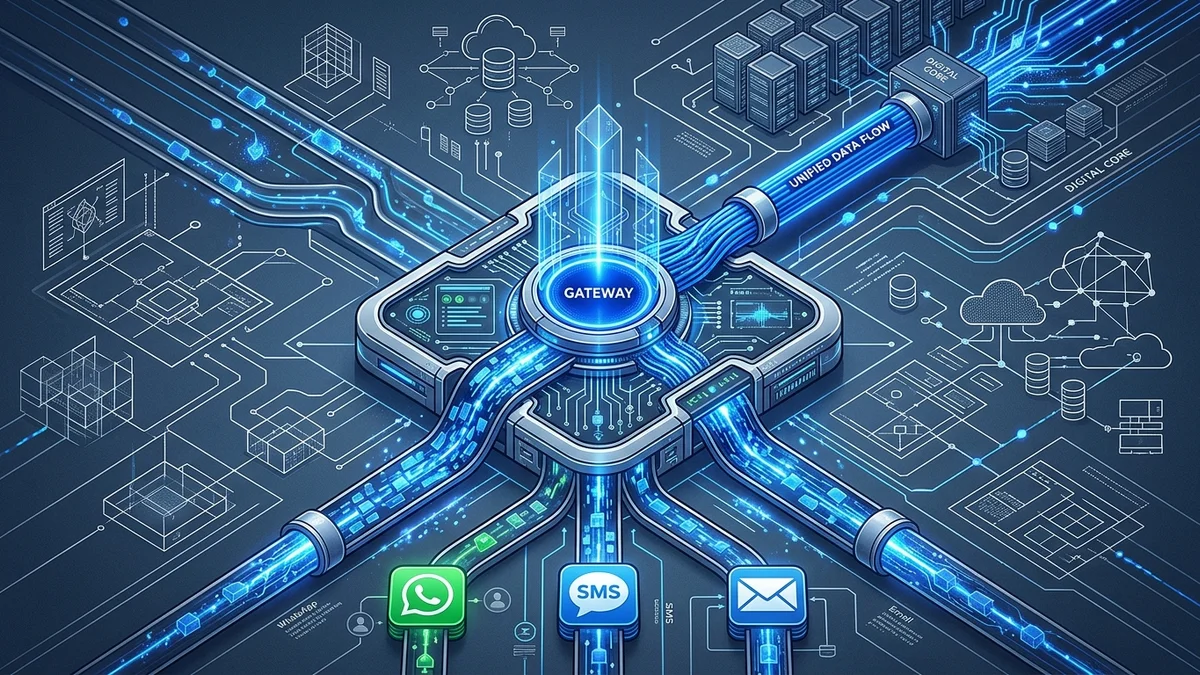
Key Takeaways
- Unified webhooks reduce API fragmentation by standardizing incoming event payloads across multiple channels.
- Engineering teams should prioritize platform-agnostic architectures to avoid vendor lock-in.
- Automated fallback mechanisms are critical for maintaining high availability in mission-critical messaging.
- Event-driven architecture, when paired with robust webhook management, minimizes latency in transactional flows.
- Centralizing messaging sessions prevents the overhead of managing individual socket connections for WhatsApp, SMS, and Email.
As modern software requirements evolve, engineering trends are shifting away from fragmented, channel-specific API implementations toward unified messaging ecosystems. For developers and architects, the challenge lies in maintaining consistent data streams while scaling across various communication platforms.
Why Are Modern Engineering Teams Abandoning Siloed APIs?
Managing individual APIs for WhatsApp, Email, and SMS creates significant operational overhead. Every platform introduces unique quirks, rate limits, and authentication requirements that drain developer velocity.
- Increased Latency: Maintaining multiple connection pools leads to resource contention and slower response times.
- Vendor Lock-in: Relying on proprietary channel features makes it difficult to migrate or pivot when provider costs spike.
- Complex Debugging: Tracking a single user interaction across disparate systems often results in fragmented data logs.
- Infrastructure Fragility: Manual session management for platforms like WhatsApp or Instagram often breaks during API updates.
Most engineering teams spend upwards of 30% of their maintenance budget simply keeping integrations current with third-party platform changes.
By moving toward a centralized architecture, teams can mitigate these risks. Understanding the hidden costs of managing multi-channel messaging sessions is the first step toward reclaiming your roadmap.
How Do Unified Webhooks Simplify Data Synchronization?
Unified webhooks serve as the connective tissue in a modern, event-driven architecture. Instead of processing platform-specific responses, a unified layer normalizes the schema into a single, predictable JSON format.
- Schema Normalization: Map disparate webhook events (e.g., WhatsApp delivery receipt, Email open) to a universal status event.
- Webhook Security: Implementing a single validation point for incoming payloads simplifies security auditing.
- Idempotency: Centralized webhook handling allows for easier implementation of idempotency keys, preventing duplicate message processing.
- Latency Reduction: Processing events at the edge minimizes the trip between the messaging gateway and your application core.
This approach is essential when scaling architecture and preventing technical debt. When your messaging layer is abstracted, adding a new communication channel becomes a configuration change rather than a development sprint.
What Role Does Architecture Play in Multi-Channel Reliability?
Reliable communication requires more than just sending a request; it demands a robust state machine capable of handling failure scenarios. High-availability systems must prioritize message delivery through automated redundancy.
- Channel Fallback: If a WhatsApp message fails due to an API error, the system should automatically trigger an SMS or Email backup.
- Proxy Rotation: To prevent account bans in high-volume environments, rotate IP proxies programmatically based on the platform's rate-limiting profile.
- Asynchronous Processing: Use a message broker to queue outgoing payloads, ensuring that peak traffic spikes don't overwhelm your downstream services.
- State Persistence: Keep session management server-side to ensure that authentication tokens persist across redeployments.
By adopting a platform-agnostic approach, you ensure your infrastructure is ready for the future, a core principle we discuss in our analysis of engineering predictions for the future of multi-channel communication.
How Can You Optimize Your Messaging Infrastructure Today?
To stop wasting time on the underlying plumbing, developers are turning to specialized infrastructure providers. Rather than building a home-grown wrapper, using a unified API allows you to focus on product logic rather than maintaining socket connections.
For instance, developers struggling with the complexity of multi-platform integration often turn to Conduit. By consolidating messaging into one API—handling everything from session management to rate limiting—Conduit removes the friction of platform-specific engineering, allowing teams to send messages across WhatsApp, Email, and SMS without rewriting their backend code for every new provider.
Stop stalling your product roadmap with technical bottlenecks and let Renbo Studios accelerate your development with high-availability systems and expert-level integration. Visit renbostudios.com today to scale your platform faster with our dedicated engineering lab.


Comments